

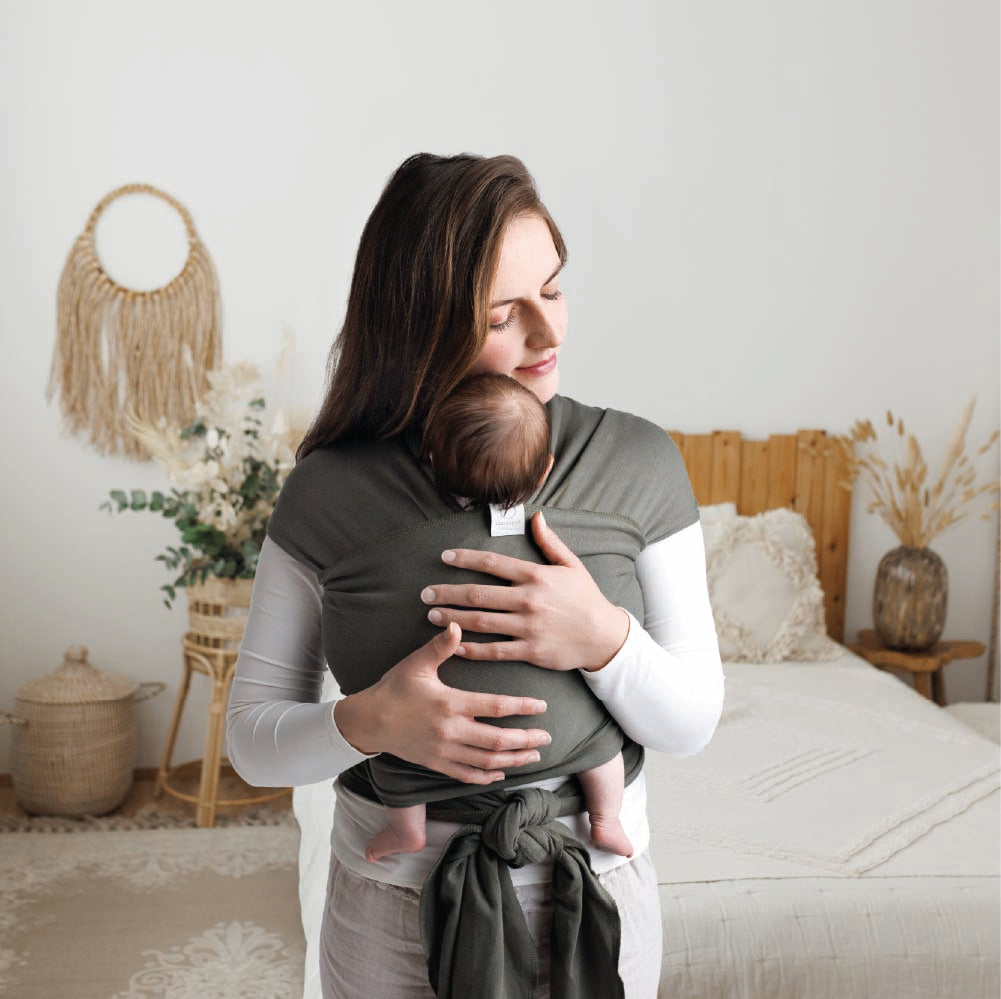
premature baby in a baby wrap?
Can premature babies be carried in a baby wrap?
Carrying delicate babies and especially premature infants in a wrap is still something many parents do less frequently. Uncertainties about whether it's allowed, possible, and how to do it play a major role here.
For Julia Pötsch, founder of cocoome, and myself as a pediatric physiotherapist and babywearing consultant, it's important to educate about how a premature baby should be carried in a wrap. Additionally, we want to give parents and family members confidence and courage to be able to carry these particularly small and delicate babies.
Table of contents:
- Education is important
- When is a baby considered premature?
- Arriving too early into the world—too bright, too loud, and just overwhelming…
- Physiotherapy supports your baby's transition into this new world
- Premature babies are natural carriers from day one
- Babywearing in a wrap offers many benefits for premature babies
- Expert babywearing advice is absolutely essential here
- Video wrap tying instructions
- Authors & Sources
From when is a baby considered premature?
A newborn is considered full-term when the baby is born in the last 4 weeks of pregnancy. This period covers pregnancy weeks 37 to 41.
If a child is born before week 37 of pregnancy (37+0), this is referred to as a premature birth. The particularly relevant groups to mention here are:
• Premature infants born before 32 weeks of gestation
• Infants with extreme immaturity born before completed 28 weeks of gestation
• Premature infants by weight under 1500g (very low birthweight)
• Babies with extremely low birth weight under 1000g
Coming into the world too soon - too bright, too loud, and all of that…
When a baby arrives too early, their maturation process in the womb is interrupted. This often leads to adjustment disorders, muscular weakness, lung immaturity, and even an immature nervous system.
Many premature babies are placed directly in an incubator after birth, which essentially mimics an artificial womb. Later, once all parameters are stable, they're transferred to a warming bed.
They're usually still connected to devices that monitor their heart rate, pulse, and oxygen saturation.
A premature baby is born into an environment that is far too bright, loud, and overstimulating for them. This can lead to sensory sensitivity and heightened responsiveness of muscle reflexes. Gravity and boundlessness are also entirely new. In the womb, the growing tightness helped them orient themselves—knowing where up, down, and the sides were. Without these boundaries, neither a newborn nor a premature baby can orient themselves. Since touch is far more developed than sight at birth, babies initially perceive their surroundings primarily through their skin. Once they can orient themselves in space through boundaries, their muscle tone (tonus) adjusts accordingly.
Once a premature baby is stable enough, no longer needs technical breathing support, feeds adequately and gains weight, reaches a certain weight threshold, can maintain their temperature, lab values are normal, and the doctor gives the go-ahead, they can be discharged home.
[caption id="attachment_24325" align="aligncenter" width="1024"]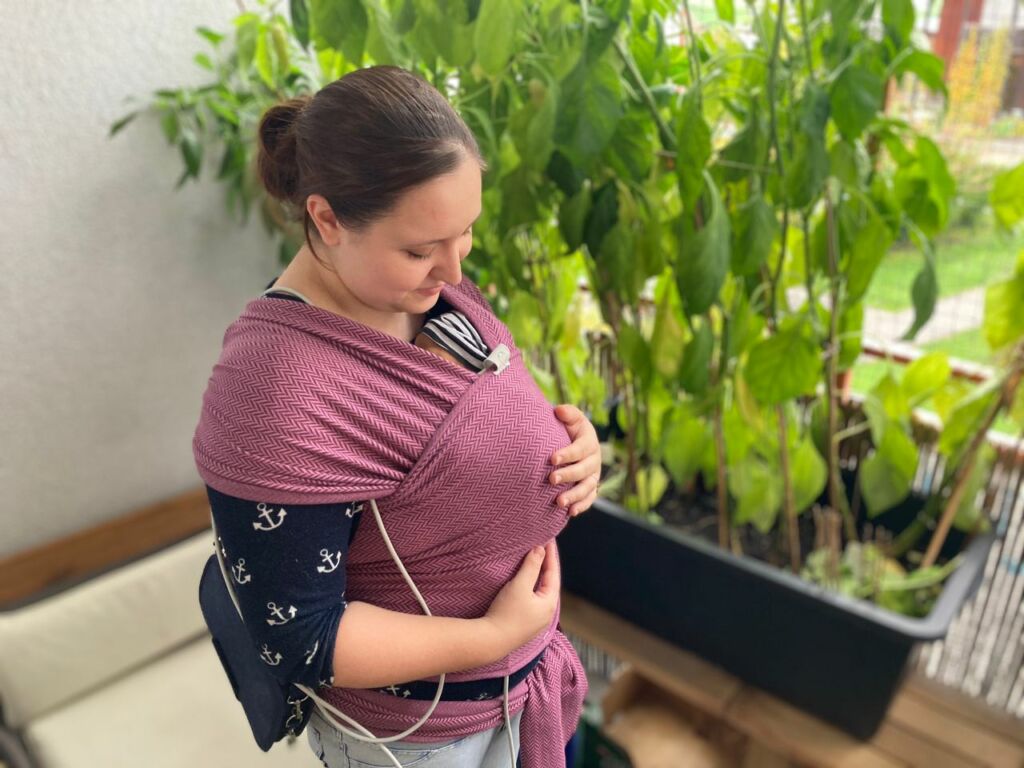 Premature baby in a baby carrier[/caption]
Physiotherapy supports your baby's arrival in the new world
Adjusting body tension and finding a stable position on the back, belly, or side is already a real challenge for newborns.
For premature babies, whose body systems (breathing, motor skills, sensory, nervous system) are not yet fully mature, this is an even bigger challenge. When premature infants come into contact with gravity too early, their muscle immaturity can lead to compensatory postures and movements. This can result in asymmetries in the trunk or head shape, as well as hyperextension tendencies.
From a physiotherapy perspective, the primary goal is to provide premature babies with as much support as possible, so they can better adapt to life with gravity and have better chances for optimal development on both the sensorimotor level (perception and movement) and the psychoemotional level (cognitive and emotional).
There are various ways to achieve this:
Through positioning and boundaries, babies can find motor calm and get to know their bodies better. Different positioning strategies for side-lying and belly positions also help prevent postural asymmetries and head deformations.
Osteopathic and craniosacral techniques are used to promote relaxation.
Breathing therapy techniques are applied to improve respiratory function and activate your baby's natural breathing.
For larger premature babies, sensorimotor development also plays an important role—helping them perceive themselves and their surroundings better.
To help your premature baby maintain stability on their back, side, or belly in space, they need proper postural control. This is practiced with your baby using various surfaces—both softer and firmer foundations. Depending on the firmness of the surface, your child must stabilize their trunk to maintain their position on their back or belly.
In physiotherapy, we also work on building tolerance for movement and shifts in balance.
Through skin-to-skin contact, touch, gentle pressure, and massage, your premature baby is helped to sense their own body and orient themselves in their surroundings.
Premature babies are carriers from the start
Carrying a premature baby in a baby wrapprovides him with protection, warmth and security. From an anthropological perspective, human infants are natural carriers. There is evidence for this. When you look at a newborn anatomically, you can see a flexed posture of the legs with a slight abduction in both the supine and prone positions. This posture is called the squat-spread position. This squat-spread position is a suitable starting position for a human infant to hold on to their mother's body. A newborn's abduction angle is 45° and is always associated with hip flexion of 100°. The child also displays this hip position when lying on their belly. In premature babies, the range of motion behaves similarly.
When picking up and lifting an infant, the squat-spread position is automatically (reflexively) assumed in anticipation of being able to cling to mother or father.
Not only the pelvis, hips and legs, but also the spine is adapted in its structure and function to being carried. In contrast to an adult spine, which has an S-shape, the infant spine is still straight and the trunk appears overall flexed in a C-position. This develops with increasing motor activity.
When your baby begins actively holding their head around 8 weeks of age, the cervical spine stretches. As your little one enters the scooting and crawling stages, the cervical spine becomes increasingly extended. The lumbar spine in the lower back develops more extension as your baby learns to sit upright, stand, and walk. Even premature infants can adopt this posture from the start.
Babywearing in a wrap for premature babies has many benefits
Babies are natural carriers from birth, and premature infants even more so. Babywearing a preemie in a wrap offers many wonderful benefits. The need for closeness and skin-to-skin contact gives your baby a sense of security and protection. This helps your little one feel calm and relaxed. The security and comfort that your preemie needs to settle down is provided through babywearing. The gentle boundaries of the wrap give your premature baby orientation and a sense of belonging. Often, breathing and heart rate stabilize beautifully once your baby experiences skin-to-skin contact.
Through continuous skin-to-skin contact between your baby and you, the bonding hormone oxytocin is produced. Often called the 'love hormone' or 'bonding hormone,' it strengthens the bond between parents and child. At the same time, it reduces stress and eases discomfort, promoting a sense of wellbeing, relaxation, and restful sleep. Oxytocin also has a positive effect on nutrient storage and cell growth. This supports healthy development, growth, and healing.
Through the balanced tension and pressure distribution in a baby wrap, your little one's muscle tone is positively influenced. Movement and balance experiences develop naturally through babywearing. Head flattening that can occur from back sleeping is prevented. The gentle, tucked position in the wrap also supports healthy hip development. On a sensory level, your baby begins to develop better body awareness and can strengthen their self-regulation abilities in meaningful ways.
Babywearing for preemies - your baby's overall condition plays an important role
For premature babies, their overall health status plays an important role when babywearing. Only once all vital signs are stable enough and there are no medical concerns can babies be carried with or without a monitor.
Premature babies weighing under 1800g should not be placed in the frog-leg position, as the abduction angle in the baby wrap can be too wide. Lighter babies are carried in a so-called Buddha position in the wrap. It's important to check beforehand how much hip abduction is already possible.
On neonatal units, infants are carried in both woven and stretchy wraps. Parents are advised and trained by qualified professionals.
Premature babies in wraps - what should be considered?
When a premature baby is carried in a wrap, from a physiotherapy perspective, the wrap should be firm enough to provide the premature baby with sufficient stability and support so it doesn't sink into the wrap. Through optimal wrapping technique, the wrap replaces the baby's missing muscular corset. When using the stretchy wrap binding method (it should ideally be a firm one like the cocoome Sling), the child can be placed in its natural tucked position, which it also shows when lying on its belly. The wrap then adapts ergonomically to the baby's torso and hips. With the third layer, which provides additional stability, you can also provide a boundary at the soles of the feet if the baby needs it.
Especially for babies who tend to straighten out, the stretchy wrap is a better choice. It hugs like a second skin. For overstimulated infants or babies who are oversensitive (especially in the neck area), the pressure distribution across the entire body can make babywearing more relaxing.
Proper babywearing guidance is absolutely essential
To ensure that carrying premature babies works well and safely from the start, and that your little one feels comfortable in the wrap, I highly recommend seeking out a certified babywearing consultant with specialized training in "carrying premature babies."
At babywearing schools like TrageberaterAkademie, Die Trageschule® Österreich and Schweiz, Trageschule Hamburg, Trageschule Wien, Trageschule Schweiz, Trageschule ClauWi, and Trageschule FTZ Babytragen, you'll find information about babywearing consultants in your region.
Wrapping instructions
[caption id="attachment_4254" align="alignnone" width="282"] Premature baby in wrap[/caption]
Author:
Anne Kohl
Pediatric physiotherapist and babywearing consultant in private practice in the Deutschlandsberg district
Here's another insightful article about babywearing and your little one:
https://www.cocoome.com/5-gute-gruende-sein-baby-zu-tragen/
Sources:
Eva Vogelgesang: IBCLC lactation consultant, babywearing consultant, nursing director of the pediatric intensive care unit in Saarbrücken. She regularly holds lectures and workshops on babywearing premature infants throughout the DACH region -> www.stillraum.com
Heike Gratzei: freelance pediatric physiotherapist and active in the neonatal intensive care unit at LKH Hochsteiermark, Leoben location
Michaela Schelldorf: head of the babywearing consultant academy, Germany
Heartfelt thanks to the three experts who supported me with their knowledge.
References:
Evelin Kirklionis: A Baby Wants to Be Held - Kösel Publisher
Sabine Hartz; Ulrike Höwer, Birgit Kienzle-Müller: Babies in Balance—Urban&Fischer
Antje Hüter-Becker; Mechthild Dölken: Physiotherapy in Pediatrics
Ute Hammerschmidt; Janine Koch: Guide to Physiotherapy in Pediatrics
Read more

Comparison: Jacket Extension vs. Baby Carrier Jacket - Pros & Cons ♥️ We at cocoome® want to extend our warmest congratulations on your pregnancy ♥️. Your little one is beginning to grow, and your ...
With the birth of your baby, so much changes and your everyday life will be completely different from before. For your baby, it's now very important to be held a lot, to cuddle, and to continue fee...